

Crowns Don’t Make Queens is available in Paperback and eBook (eBook on sale until the end of September).
Loved Humans Don’t Have Horns? Here’s how you can help it reach the readers who need it most :
-
Leave a review on Goodreads — it makes a real difference
-
Request it at your local library — it’s free for you and opens the door for new readers
Haven’t read Humans Don’t Have Horns yet? It’s available on KU, in paperback, and the audiobook is widely available across major platforms. All links in my Linktree.
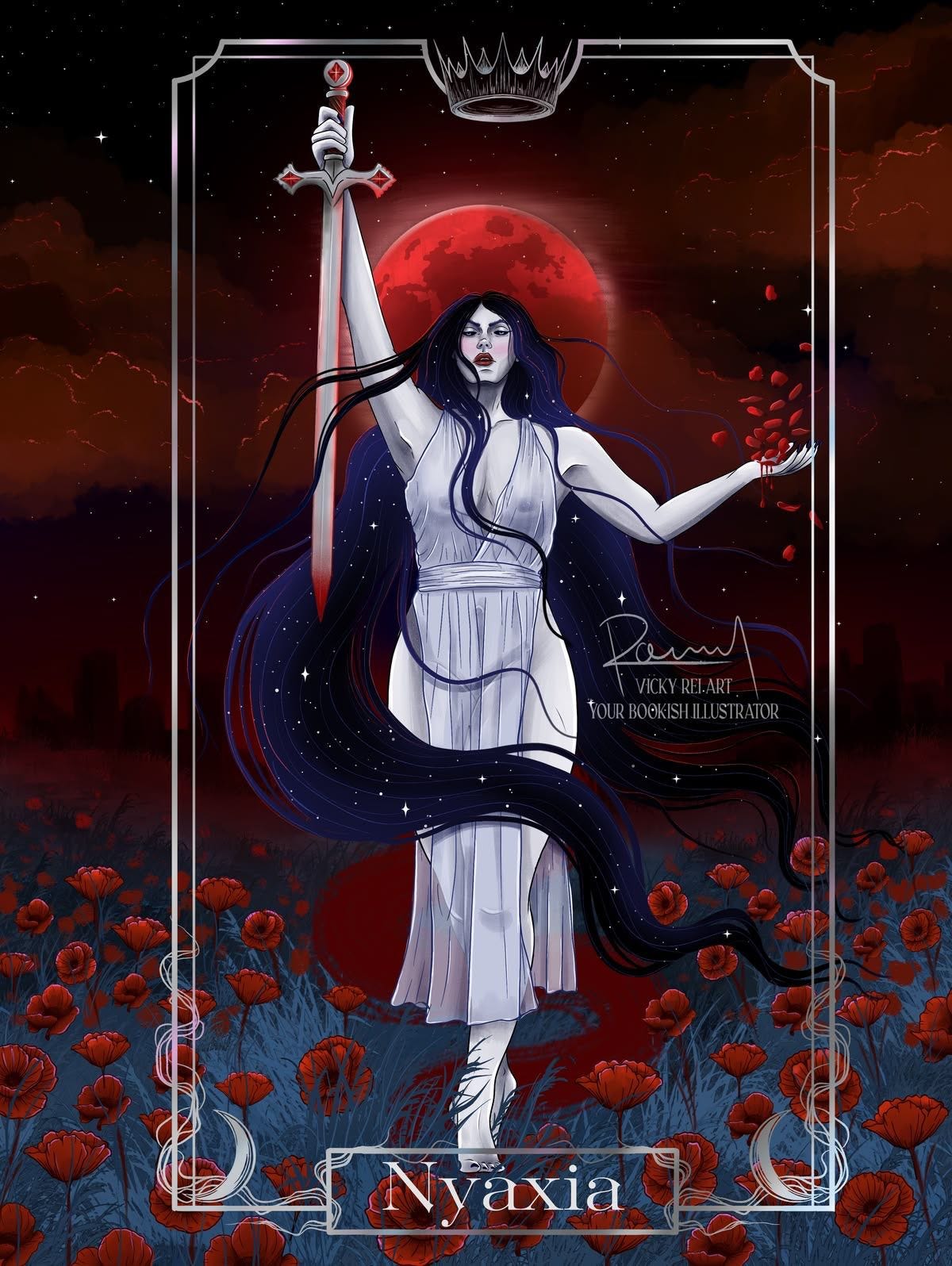
I’m writing the third book in the trilogy Crown of Blood and Magic, and so the Gods occupy my mind at the moment.
Of course, Fantasy and Romantasy didn’t invent the Gods. They are built on thousands of years of mythology. From ancient Greece to Hindu traditions to Egyptian mythology and Norse folklore.
Yet it seems that, more than any other mythology, Western fantasy is inspired by Greek concepts of Godhood. A huge ensemble of characters who lust and envy. They can be generous and protective in one story and absolutely terrifying in another. They are high on their superiority over mortals. They also bed mortals.
Crowns of Nyaxia
When you read Crowns of Nyaxia, it is impossible not to see its origin in Greek mythology. I’m currently reading the fifth book in the series, The Lion and the Deathless Dark. I’ve reviewed the first book in the series, The Serpents and the Wings of Night, and it remains my favorite vampire series.
The worldbuilding, to an extent, is based on the gods and their wars. Nyaxia is the exiled goddess whose husband, Alarus, the god of death, was murdered by the White Pantheon because of their forbidden relationship. After his death, Nyaxia created the vampires.
The pantheon expands well beyond Nyaxia. There’s Acaeja, goddess of fate, Atroxus, god of the sun, Shiket, goddess of justice, and many more.
The gods in Crowns of Nyaxia, cheat and betray, and the mortals live with the consequences.
A bit of a spoiler here: as the series progresses, Broadbent suggests that the death of the gods would save humanity. It’s an incredibly tempting solution. The gods manipulated mortal history for thousands of years. Kill the gods. Problem solved.
While I enjoy reading it, I’m not sure it resonates with me in my own world-building. I’ll elaborate more at the end of the post.
But this made me think of two other books I loved reading.
Can the Gods exist without us?
Stay with me here, because I’m starting with Tinker Bell.
Tinker Bell is obviously not a god. She’s a fairy. But Peter Pan contains the concept of a being whose survival is connected to human belief.
In the original play, Tinker Bell is dying, and Pan turns to the children and asks them to believe in fairies. As a result, Tinker Bell recovers.
In ’s dark romance retelling, The Never King, Pan tells Tinker Bell that he does not believe in fairies. Because words of disbelief are literally fatal to the Fae in this universe, his words kill Tinker Bell on the spot.
The relationship between gods and believers is at the heart of Neil Gaiman’s American Gods. The old gods arrived in America with the people who believed in them. But as the generations passed, the children of the immigrants stopped worshiping the old Gods, and even stopped remembering them altogether. The gods need us more than we need them in this novel.
Sarah J. Maas: Were they ever even Gods?
In Crescent City, the Asteri present themselves as Gods. They control enormous sources of magic and power. But in truth, they are parasites who feed on the magic in the realms they conquer.
Since ACOTAR 6 — A Court of Splintered Harmony is coming out on October 27, there is no end to the theories on Mass’ world-building. But House of Flame and Shadow makes the connection clear by revealing that the Asteri and the Daglan from Prythian’s ancient history are the same kind of beings. And that they can be defeated, since they were defeated in the past.
Do all Gods Deserve to be Worshiped?
In a way, this takes me to immediate family. Do all parents deserve gratitude and love? Is creating you enough?
You can know a god exists and despise her. You can worship a god you fear. Religion plays a big part from the beginning of Humans Don’t Have Horns, although I didn’t create a huge, detailed pantheon.
But already in the first book we can learn of the Gods’ role.
I chew my lip. “Isn’t it blasphemy for you to suggest there’s another god and not only the Goddess?” Because he’s very religious, as far as I can tell.
“The question is not how many gods there are. It’s how many you worship.” He shrugs.
“And you think they’re vindictive?” I ask to affirm his meaning.
He sighs, “I don’t think. I know.”
In Crowns Don’t Make Queens, as the series progresses, we meet the Goddess in person, and we see that she does horrendous things. Which leaves me with the question I started with: What do you owe a god simply because they’re a god? Maybe nothing.
Crowns of Nyaxia presents a divine system in which the deaths of gods reshape mortal civilization, and this might be its salvation. But what if the world needs them anyway?
The Problem With My Gods
Spoilers for the Crown of Blood and Magic trilogy from here. Paid subscribers only.

