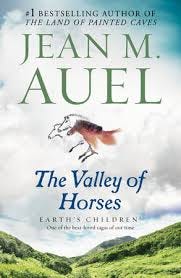
If you love smart worldbuilding, resilience, and a romance that rises from the ashes, meet Humans Don’t Have Horns.
It’s widespread now: eBook: Amazon Kindle + KU; Paperback: Amazon, Barnes & Noble online; Audiobook: Audible, Apple Books, Spotify, Kobo, Everand, Storytel and Barnes & Noble
The Plot
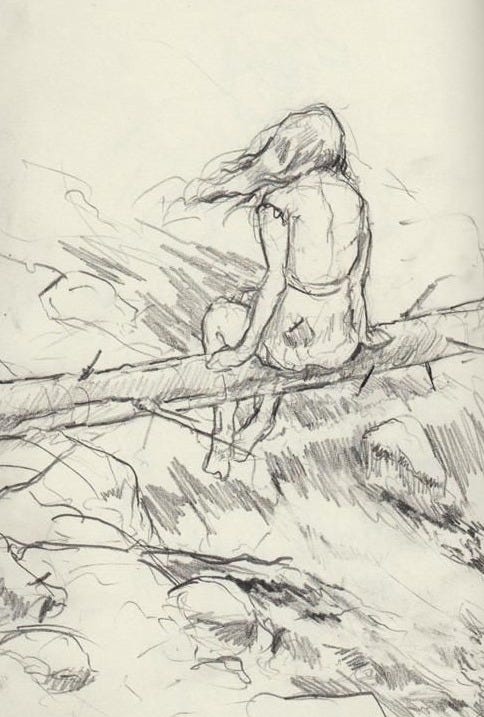
Banished at the end of The Clan of the Cave Bear, Ayla enters Book 2 utterly alone. The death-curse placed on her means she is forbidden from taking her infant son with her, so Ayla must build a life build a life entirely on her own in a harsh valley shaped by ice and wind. She learns the land’s rhythms, innovates tools and medicine, and forms a bond with the wild horses that share her refuge.
Across the continent, Jondalar journeys with his brother, his path slowly bending toward Ayla’s. When their stories finally intersect, what follows is tender, awkward, and complicated, two people, divided by language and culture, slowly falling in love.
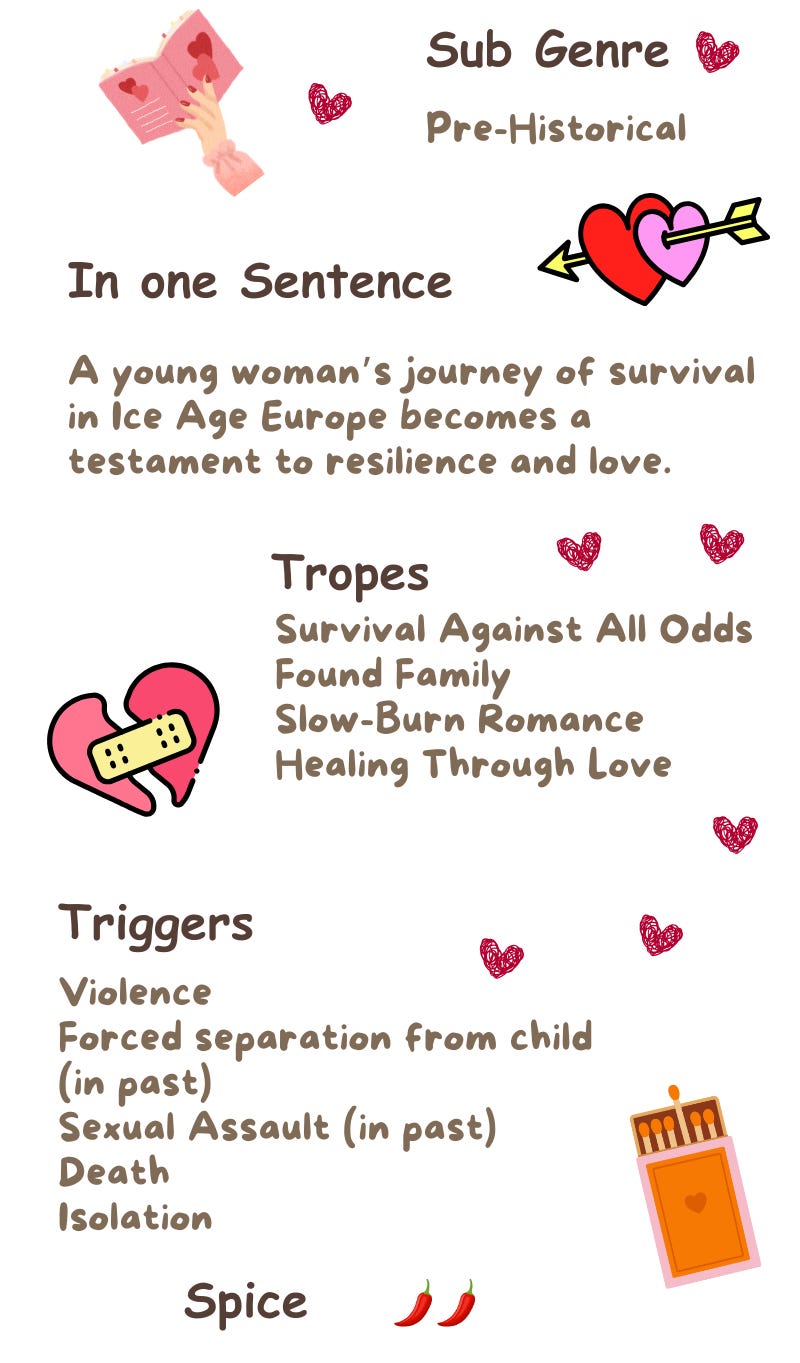
This is book two out of six books. Book one contains no romance and takes Ayla through horrific experiences, so I skipped straight to book two.
My Breakdown
This book gave me:
✨ The fiercest, most tactile survival sequence I’ve read
🐎 A timeless human–animal bond
💔 Separation grief that shadows every success
💞 A romance that grows through misunderstanding, patience, and small mercies
In 1977, Auel began extensive library research of the Ice Age for her first book. (By the way she was in her forties and coming from a business career when she started working on her first book). She joined a survival class to learn how to construct an ice cave, and learned methods of making fire, tanning leather, and knapping stone from an aboriginal skills expert. After the success of her first book, Auel has been able to travel to the sites of prehistoric ruins and relics, and to meet many of the experts with whom she had been corresponding. Her research has taken her across Europe from France to Ukraine.
Jean M. Auel’s obsessive archaeological and anthropological research is the engine here. The craft, the plants, the shelters, the social problem-solving, so much of it that you imagine yourself as living in the story.
The coolest part is that Auel popularized ideas that sounded speculative in the 1980s, like close contact between Homo sapiens and Neanderthals. She was right when other scientists insisted Neanderthals and Homo sapiens weren’t able to reproduce. “I guess we all have a little bit of Neanderthal DNA in us,” and guess what? Apparently that’s what they’re coming up with now!” She said in an interview 30 years after her book was published. She also suggested Neanderthals communicated with each other, which was later on shown.
The writing which is filled with details and description of making fire, mixing poultices, testing a new tool, carry as much weight as the big emotional beats.
Ayla is in a way that kick ass heroine we love in romantasy. I think writing a character like Ayla in the 80’s speaks highly of Auel. I also enjoyed the Matriarchy version we get to see in this book, as opposed to the patriarchy of the clan.
Jondalar is very sweet and is the balm to Ayla’s wounds. He’s gentle, considerate and together they work through language barriers and the culture gap. This is not escapist lust; it is two people deciding to be brave with each other.
The book was adapted to a cinema version but it famously missed the soul of Auel’s work so badly that she later took legal actions against it and in interviews she has been clear she was not given the creative input she had been promised.