

Crowns Don’t Make Queens will be published on August 31, 2026. Pre-orders are now live for just 0.99$.
Loved Humans Don’t Have Horns? Here’s how you can help it reach the readers who need it most :
-
Leave a review on Goodreads — it makes a real difference
-
Request it at your local library — it’s free for you and opens the door for new readers
Haven’t read Humans Don’t Have Horns yet? It’s available on KU, in paperback, and the audiobook is widely available across major platforms. All links in my Linktree.
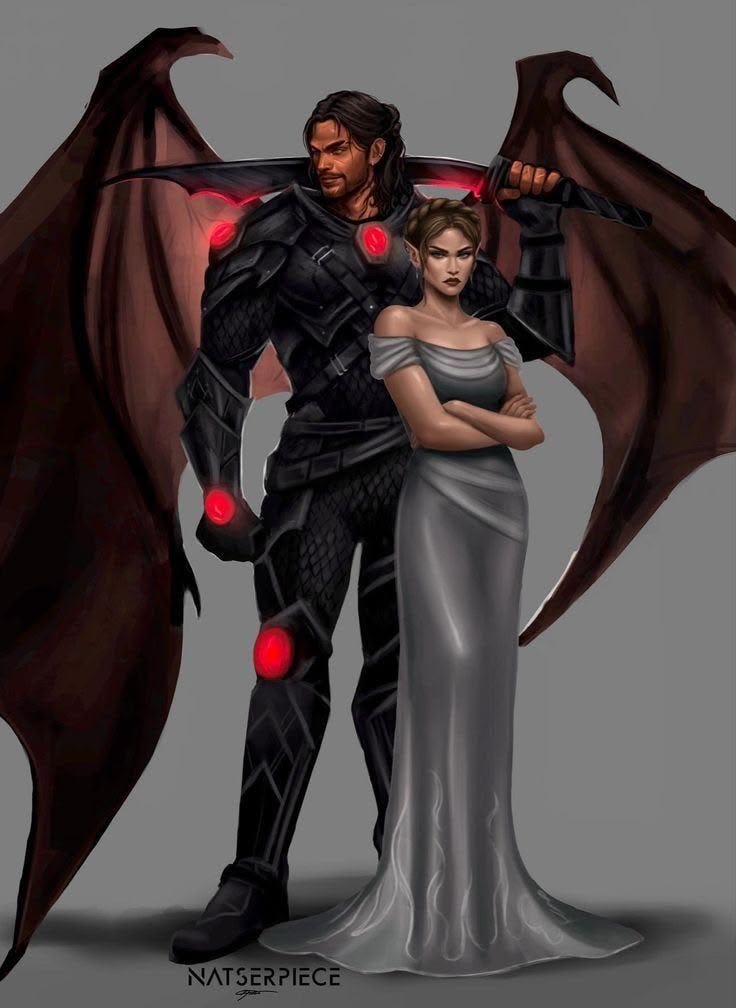
If you read romantasy, you know the moment.
The pull. The scent. The invisible thread. The sudden realization that this person is your mate.
Fae have mates. Werewolves have mates. Sometimes the characters recognize each other instantly. Sometimes one knows, and the other doesn’t. Sometimes they spend several hundred pages fighting the inevitable.
Fated mates have become such a huge part of romantasy that they can almost feel like something the genre invented. But the concept of fated mates is much, much older than romantasy.
We Have Been Looking for Our Other Half for Thousands of Years
The Greeks believed Zeus split souls apart, condemning them to spend their lives searching for their missing half.
Chinese folklore gave us a red thread of fate, connecting people destined to meet or marry.
Jewish tradition has bashert; it goes back to older rabbinic ideas that 40 days before a baby is born, the heavens decide on their soulmate.
Different cultures. Different theology. But it shows us that humans have long been obsessed with the same question: What if love isn’t random? What if there is one person you were always supposed to find?
Romantasy (and for the sake of this post, paranormal will be treated as part of romantasy) takes it a step further. The universe doesn’t merely suggest that these people belong together; their supernatural bodies can actually identify each other.
They get to know their fate, while we can only believe in it.
And then Sarah J. Maas came along
Obviously, Sarah J. Maas didn’t invent fated mates. But it would be difficult to discuss how mainstream the concept has become in romantasy without mentioning A Court of Thorns and Roses. ACOTAR made Fated Mates part of our everyday bookish vocabulary.
And what I find most interesting about Maas’s version is that being someone’s mate doesn’t actually solve the romance. It often makes it considerably more complicated.
Look at Feyre and Rhysand. Feyre is the last person to learn what their connection actually is, and that revelation becomes tangled up with trust. Why didn’t he trust her enough to tell her?
Nesta and Cassian make it even messier. Nesta doesn’t respond to discovering the bond with Oh, wonderful, the universe agrees with me. She’s angry. Because once fate enters the relationship, it creates a horrible little question: Do you want me because I’m me, or do you want me because I’m your mate?
And now we have Elain and Lucien. They both know they’re mates. Yet, Elain still hasn’t chosen him. We’re all holding our breath for A Court of Splinter Harmony to come out this October to see who Elain chooses.
Maas herself has described mating as having a biological component and acknowledged that one can be mated to someone who isn’t necessarily their true love. Which makes it all less romantic?!
Then came the werewolves
Modern paranormal romance took a similar direction to Mass, but in a different way. The emphasis is on physicality. You are compelled to hump that person that you can’t even stand.
There is a lot written about werewolf mates, Alfas and Omegas, including here on Substack, so I won’t try to turn this into a deep-dive of shifter romance. Werewolf and shifter romance has built an entire genre vocabulary around mates: Knotting, nesting, claiming, marking, rejected mates, scent recognition, and there is pan when mating is being denied.
Is it romantic? Not sure. Is it sexy? Yes, it is.
Why are mates so effective in romance?
In a way, it is, to me, another hyper version of the Forced Proximity trope. Which is one of romance readers’, and my own, beloved tropes.
The mates are compelled to find themselves in proximity, regardless of the ongoing conflict the author creates to deny us the desired catharsis.
I Made a Different Version
While writing the Humas Don’t Have Horns, I created bloodmates. Yet only in Crowns Don’t Make Queens do we learn the extent of the meaning of the Blood Oath.
Lian and Daton aren’t bloodmates because fate decides they belong together.
The Blood Oath is voluntary. Daton specifically tells Lian that he will never pressure her into it. She has to want the bond. And she does.
They decide. Which makes a lot of people and a certain Goddess extremely unhappy.
I called them bloodmates since the act included blood. But really, they bind their souls.
Spoiler coming
The oath changes them. Daton’s blood gives Lian access to his power. Daton can sense her even when she’s days away from him.
And the bond is not just for this lifetime. Bloodmates remain bound after death. I haven’t seen a fated-mate example that addresses the bond effect after death.
That’s why becoming bloodmates is different from marriage in Mongan culture. You can marry someone without taking the Blood Oath. Becoming bloodmates is an entirely different level of commitment.
There’s another layer I think is particularly distinctive: bloodmating isn’t only romantic worldbuilding in the trilogy; it’s entangled with the central mythology. Mongan blood contains the power of the stars; their magic has been blocked by the Goddess, and Daton and Lian’s Blood Oath creates a loophole in that divine punishment, setting off a chain of events that pushes us into the third book in the trilogy.
Which One Is Actually More Romantic?
There is something undeniably romantic about fated mates. Aren’t most people in the single market would find it comforting to know that The One is out there, waiting for them? No uncertainty. Every bad date just brings you closer to the perfect date.
But as popular as the fated mate trope is, many struggle with the question of choice. Isn’t it more romantic to know someone chooses you, despite, and sometimes due to, your imperfections?
Which version is more romantic to you? When fate decides, or when you get to?
Some of the links I share will be affiliate links. I’ll still only recommend books I genuinely loved (honest reviews, always). If you buy through one of my links, I may earn a small commission at no extra cost to you.

