

Loved Humans Don’t Have Horns? Here’s how you can help it reach the readers who need it most :
-
Leave a review on Goodreads — it makes a real difference
-
Request it at your local library — it’s free for you and opens the door for new readers
Haven’t read Humans Don’t Have Horns yet? It’s available on KU, in paperback, and the audiobook is widely available across major platforms. All links in my Linktree.
Spend enough time on BookTok, or even at Barnes and Noble, and you start to notice how fantasy romance is increasingly marketed through tropes. Enemies-to-lovers. One bed. Fated mates. Touch her and die. Shadow daddy. Morally gray hero. Vampire king. Fae prince. The shorthand has become so familiar that readers can often predict the shape of a book before reading a single chapter.
There is nothing inherently wrong with that. Tropes help us find stories that deliver the emotional experiences we are looking for. But listening to the conversation surrounding romantasy today, one could easily come away with the impression that the fantasy part itself has become secondary. That worldbuilding, politics, mythology, and the vast sense of discovery that once defined Fantasy Romance are slowly being replaced by trope-centered storytelling.
I don’t think that’s actually true.
In fact, I would argue the opposite.
The loudest conversation in fantasy romance may be about tropes, but many of the books that have defined the genre’s last decade succeeded because they had genuine and vast world-building.
I’ll give three examples from my favorite romantasy authors. But there are so many other examples (and some of you might think even better ones). I’ll focus on world-building this time. I also plan to do a deep dive into political intrigue in the future, because I think that while there are similarities between world-building and political intrigue, they are not the same.
Sarah J. Maas
Her haters reduced her book to Fae-Porn, missing that she creates large epic fantasy universes. “The Maasverse” is an interconnected universe spanning three series: Throne of Glass, A Court of Thorns and Roses, and Crescent City. Entire fan communities are dedicated exclusively to tracking cross-series connections.
If readers only cared about the romance, nobody would be building spreadsheets, timelines, family trees, and multiverse theories connecting three separate series that span sixteen books.
Yet that is exactly what Maas readers do. For years, fans noticed recurring symbols, repeated myths, similar magical artifacts, and references that seemed too specific to be coincidences. Long before Maas officially confirmed major crossovers, readers were theorizing that the worlds might be connected.
A romance can make readers cry.
A fully realized world can keep them theorizing for fifteen years.
Carissa Broadbent
At first glance, Crowns of Nyaxia looks like a trope-first series: vampires + tournament + enemies-to-lovers.
But when you start examining the world, you discover an enormous amount of underlying structure. The vampire society isn’t one kingdom. It’s three major Houses: House of Night, House of Shadow, House of Blood. Each has different abilities, histories, political structures, and relationships with the goddess Nyaxia.
Then, beyond the Houses, Broadbent built a full pantheon of gods, competing religions, cults, underworld mythology, magical inheritance systems, and much more.
One thing that struck me while researching is that Broadbent has publicly posted a glossary for the world on her website. That’s not the behavior of an author who’s basing her writing on tropes.
Leigh Bardugo
Bardugo said in interviews that when she began building the Grishaverse, she deliberately set out to move away from the default fantasy setting of medieval England and Western Europe. She became fascinated by a Russian imperial atlas and started researching trade routes, military campaigns, borders, and the social structures of Tsarist Russia. That research became the foundation for Ravka.
The Grishaverse is an entire geopolitical system. Ravka is inspired by Imperial Russia. Fjerda draws heavily from Scandinavian influences. Shu Han incorporates elements inspired by East Asian and Mongolian cultures. Kerch, and especially Ketterdam, draws from the Dutch Golden Age and mercantile republics.
Each nation has its own economy, religion, prejudices, military interests, and relationship with Grisha magic.
The Grishaverse now includes:
-
The Shadow and Bone trilogy
-
The Six of Crows duology
-
The King of Scars duology
Ketterdam is a major center of international trade where virtually everything can be bought and sold. The city’s economy, criminal networks, and political interests are so developed that they become as important as the characters.
Bardugo asks Who has power? Who has money? Who controls trade? What prejudices exist? Who benefits from the system and who suffers under it?
Even ten years after Six of Crows, Leigh Bardugo returns to the Grishaverse with Six of Crows: A Darker Shore: Letters from Ketterdam, a short story releasing on June 30, 2026, and available for a special pre-order price now. Set years after the events of Crooked Kingdom, it follows two investigators as they piece together a deadly island massacre using found documents, including letters from Kaz Brekker.
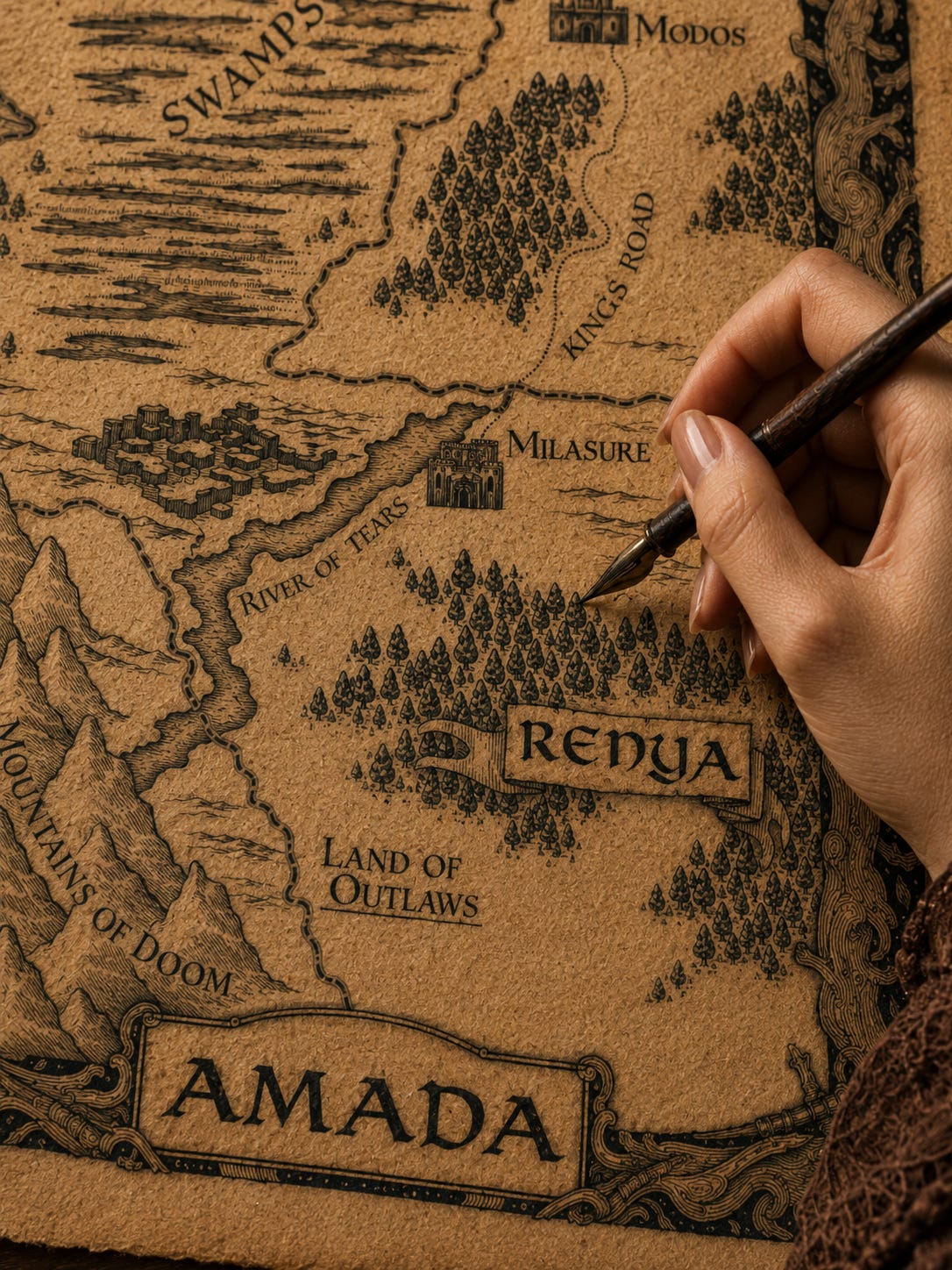
What I Wanted to Build in Amada
When I sat down to write Humans Don’t Have Horns, I knew it would be a romance, but I also wanted to explore how societies construct narratives and how easily we dehumanize others.
In a previous life, before I became a fantasy author, I earned a PhD in political science and taught at university. I was always interested in the way societies organize themselves and the stories they tell to justify that organization.
Who gains power from this?
The Puresouls believe the horned Mongans are cursed. The Mongans dehumanize Lian only for being a Puresoul. Both sides inherit histories, prejudices, fears, and grievances that existed long before page one in the book.
The conflict between Puresouls and Cursed Ones is not simply a conflict between two peoples. It is a conflict between competing versions of history and competing understandings of what it means to be human.
The Cursed Ones’ horns become important not because of what they are, but because of what people believe they represent.
In that sense, the worldbuilding of Humans Don’t Have Horns is less about escape and more about exploration. The kingdoms, religions, histories, and political conflicts exist because they allow me to ask questions about power, identity, prejudice, and belonging.
Fantasy offers a unique opportunity to examine those systems from a distance. By creating an unfamiliar world, an author can sometimes prompt readers to ask different questions as they read the news. When the barbarians are not what they seemed. When the underdog is also capable of terrible things. They should always ask: Who gains power from this?
For more about Humans Don’t Have Horns’ world-building, start here
What’s your favorite romantasy world-building?
Some of the links I share will be affiliate links. I’ll still only recommend books I genuinely loved (honest reviews, always). If you buy through one of my links, I may earn a small commission at no extra cost to you.

