


Last week I reviewed TOG and Maas’s success and impact on romantasy. If you missed it, here is the post.
First, an unpopular POV: There’s something in common with both TOG and ACOTAR (okay, there are more things, but let’s start at the beginning)—the first book in each series is pretty weak. So weak, in fact, that I never would have continued to book two if a friend hadn’t promised it gets better. It could be because TOG was Maas’s debut novel, and her writing improved significantly afterward—but that doesn’t explain ACOTAR. Interestingly, in Crescent City, the first book is arguably the best of the series, although all the books are great.
Perhaps the reason the first books in TOG and ACOTAR don’t resonate as strongly is because the initial romantic interests aren’t the endgame characters, allowing the romances to fully ignite only in subsequent books.
I’d love your thoughts—why do you think ACOTAR and TOG only really hit their stride in book two, or maybe I got it all wrong and book one worked for you just as much?
Maas’s Craft
Critics often praise Maas’s world-building and character development, highlighting her talent for crafting detailed mythologies and expansive casts that deeply engage readers.
What I admire in Sarah J. Maas’s writing
✨ Cinnamon Rolls – all of the main MCs in her books might be gray characters to the world, but to their FMCs, they are the best—the wind beneath their wings and everything that is sweet. A lot has been said over the years about the positive sex in Maas’s books, which is true, but she also writes men who are supportive of their women—alphas who don’t need their female partners to be their betas. Because Maas gets what Tamlin doesn’t – a woman can be a High Lady.
✨Tension – one of the biggest challenges in writing romance series is maintaining tension. Romance readers know that once the main romance reaches its peak, it becomes challenging to keep readers engaged. Maas excels at this. Typically, the romance fully blossoms in book two, yet she keeps readers returning for more books in the series. Her secret might be her expansive ensemble of characters, allowing multiple romantic subplots that keep us romance junkies satisfied. As a beginning writer, I feel this is a great aspiration.
✨ Found family – Maas excels at creating that feeling of a space readers dream of living in, and I believe it has a lot to do with the found family arc she develops in each series.
What I don’t like in Sarah J. Maas’s writing
🔹 Everyone is beautiful. Recently, I tried explaining this to a friend using an example from Ali Hazelwood’s Deep End, where the FMC mentions that she has a rash. In Maas’s books, no one would ever have a rash! Everyone is eternally youthful (even characters thousands of years old appear in their twenties) and impossibly beautiful. To me, this makes characters less human (yes, even the fae) and less relatable.
🔹 Repetitiveness – I haven’t counted the number of times the phrase “like calls to like” shows up in ACOTAR, but if I had a dollar for every time it did, I could probably buy my own Night Court.
🔹 Aedion Ashryver – He doesn’t deserve Lysandra, and he’s too busy whining instead of actually living up to Maas’s male character standards. I don’t like him!
🔹 There is another feature that is missing in Maas’s writing—but I’ll delve deeper into that in next week’s post, which will explore another romantasy issue.
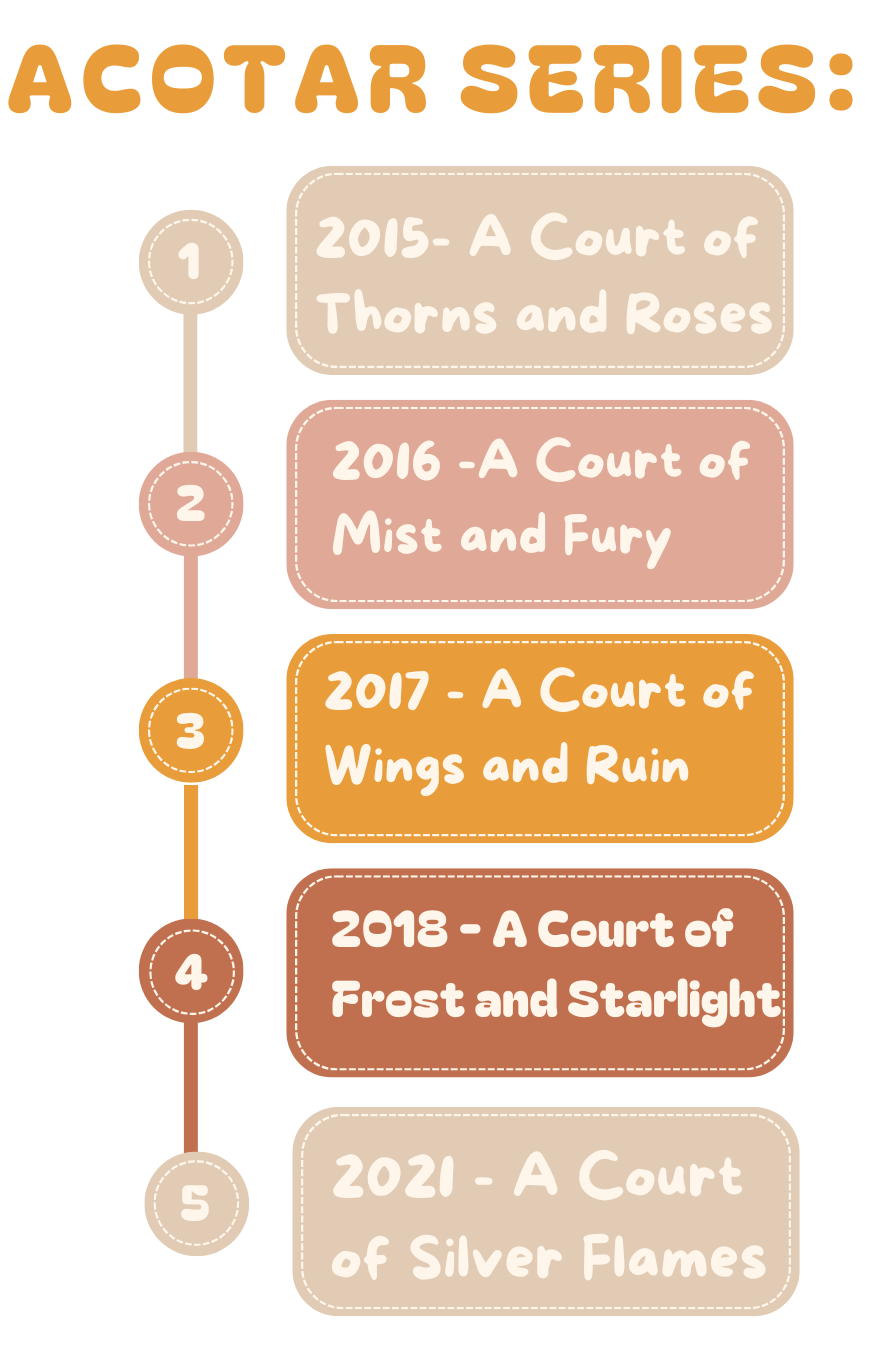
Notably, a sixth ACOTAR book is confirmed. This series marked Maas’s expansion into mature content, solidifying the “romantasy” subgenre ,and attracting mockery as “faerie porn” by sad, sad people.
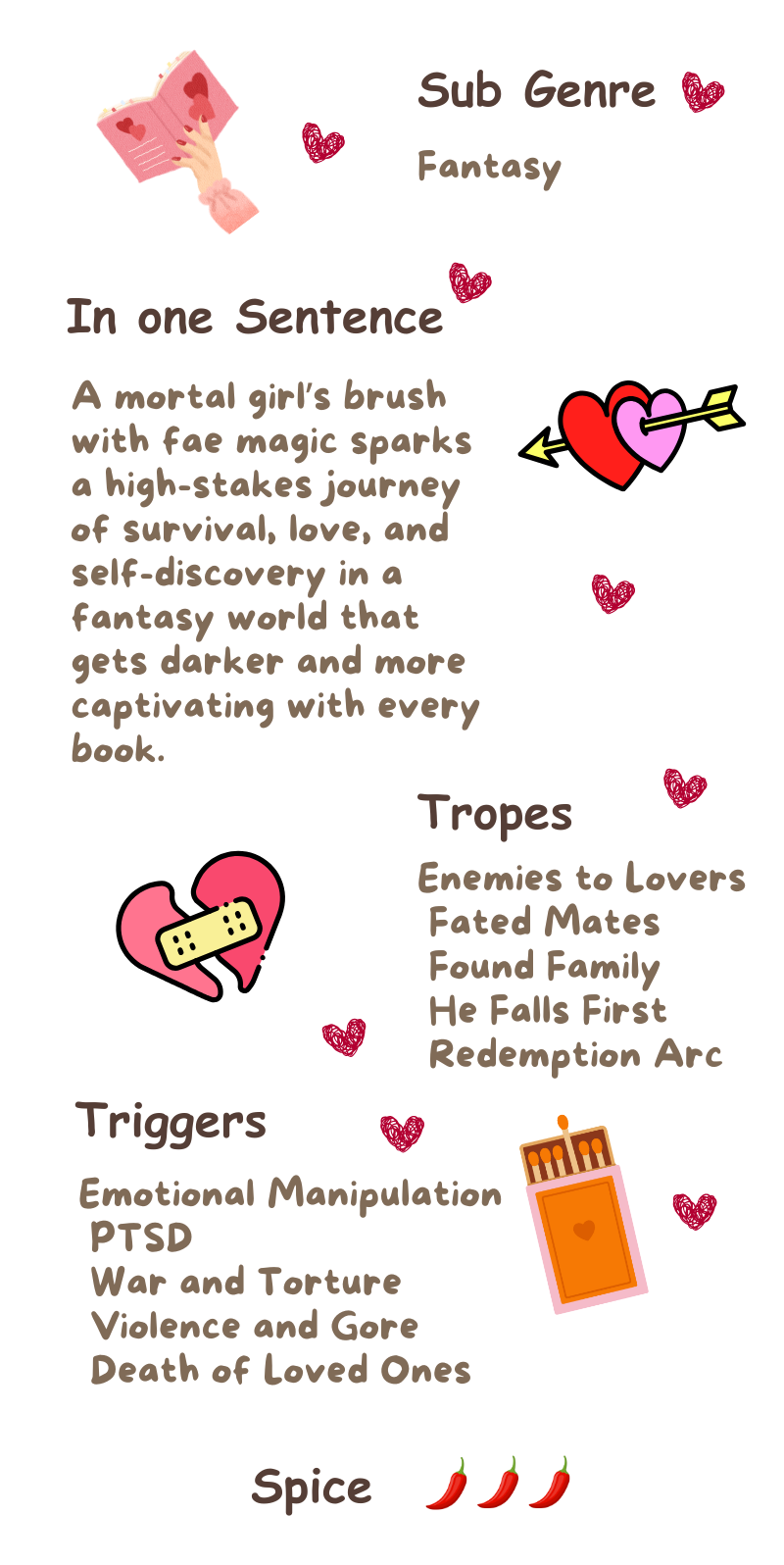
The Plot
Feyre Archeron is a mortal huntress scraping to survive when she kills a wolf in the woods—and ends up dragged into the magical, deadly world of the fae as punishment. What begins as a fairytale romance quickly evolves into something far more powerful. Feyre isn’t just a damsel or a prize—she becomes a weapon, a ruler, a force to be reckoned with. And the men in her life? They grow with her—or get left behind.
My Breakdown
ACOTAR explodes into a raw, romantic, and emotionally complex story about healing from trauma and reclaiming your power.
Feyre goes from broken and passive to a woman who demands more—of herself, of her lovers, and of the world around her. She doesn’t heal in a straight line. She makes messy, painful, gorgeous choices.
And then there’s Rhysand.
Allegedly gray, but really the sweetest and most romantic MC ever written.
And I said into it, You are so good, Rhys. You are kind. This mask does not scare me. I see you beneath it.
I love that he was the platform for Feyre’s growth. And the spice between these two? The most satisfying Maas has ever written. She managed to entangle it with such explosive romance that it’s no wonder chapter 55 became iconic.

I would have waited five hundred mor years for you. A thousand years. And if this is all the time we were allowed to have… the wait was worth it.
Again, great ensemble of characters. Morrigan, Cassian, Azriel, Nesta, Amren, Elain — they’re not side characters, they’re family.
And the spinoff (A Court of Silver Flames) turns Nesta into one of the most complex gray characters (yes, far more than Rhysand), and one of the most beautifully redeemed heroines in fantasy.
ACOTAR is a trauma book. A sex-positive, emotionally raw, slow-burn romance. SJM doesn’t shy away from grief, rage, or healing. Her characters are allowed to fall apart. And then they’re handed swords and given the space to fight their way back.
Further Reading
-
Maas, Sarah J. Official Website
-
Vox (Constance Grady) – “Why Half the People You Know Are Obsessed With This Book Series” (Feb 27, 2024)

